Home / News / Industry news / Polar Fleece Fabric: GSM Guide, Properties & Sourcing Tips for Wholesale Buyers
2026-05-20
Content
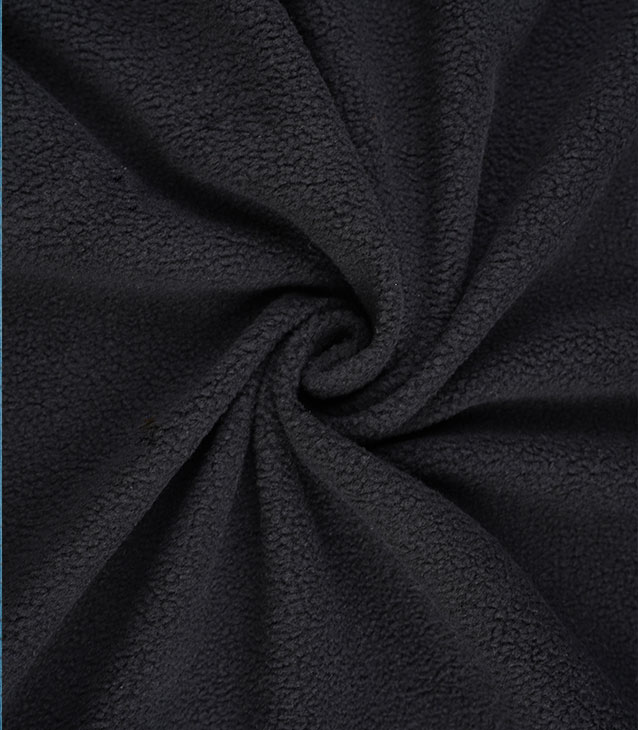
Polar fleece is a double-sided knitted fabric made from 100% polyester filament yarns—commonly 75D/144F, 100D/36F, or 150D/144F—that are brushed on both faces to raise a dense, uniform pile. That two-sided napping is what sets it apart from single-sided alternatives: both surfaces trap air, resulting in consistent insulation regardless of how the garment is oriented or how the fabric is cut.
The fabric was originally developed in the late 1970s as a lightweight synthetic alternative to wool, and it has since become one of the most widely used materials in cold-weather apparel. Unlike woven fabrics, polar fleece is a knit construction, which gives it inherent stretch, recovery, and cut-and-sew versatility. Edges don't fray, which simplifies garment production significantly. For manufacturers sourcing materials at scale, this translates to lower cut waste and faster line speeds.
For warp-knitted constructions specifically, the dimensional stability and pile consistency tend to be tighter than in weft-knitted variants—an important distinction for buyers specifying technical outerwear or performance activewear. You can explore warp-knitted polar fleece fabric for outerwear and activewear to understand how knitting architecture influences final performance.
GSM—grams per square meter—is the single most important specification when sourcing polar fleece, but it's also one of the most misunderstood. Weight determines not just warmth, but hand feel, drape, manufacturing behavior, and retail price point. Two fabrics at the same GSM can perform very differently depending on pile structure and knit density, so treat GSM as a range boundary, not a fixed promise.
| Weight Range | GSM | Best Applications | Key Trade-offs |
|---|---|---|---|
| Lightweight | 100–200 GSM | Base layers, hoodies, spring/fall activewear, linings | Excellent breathability; lower insulation in extreme cold |
| Midweight | 200–300 GSM | Everyday jackets, sweatshirts, blankets, everyday outerwear | Balanced warmth and breathability; broadest commercial appeal |
| Heavyweight | 300+ GSM | Winter jackets, outdoor gear, premium home textiles | Maximum insulation; reduced breathability during high-output activity |
Midweight fleece in the 200–300 GSM range remains the most commercially dominant category, covering everyday winter apparel through moderate outdoor use. Lightweight options below 200 GSM are gaining ground in athleisure and layering applications, where packability and moisture management matter more than raw warmth. At the heavy end, fabrics exceeding 300 GSM are specified for garments designed to replace insulated shells in very cold environments or for premium blanket and bedding products.
When placing bulk orders, smart buyers define an acceptable GSM band—say, 220–260 GSM—rather than a single figure, which gives the supplier room to optimize pile density and fiber fineness within controlled limits. Always request GSM verification on pre-production samples, as batch variation is one of the most common quality complaints in fleece sourcing.
Polar fleece insulates by trapping a layer of warm air within its pile structure. The goal isn't maximum thickness—it's efficient air retention with controlled airflow. Fabrics that block airflow completely feel warm at rest but become clammy during physical activity. For active-use products, breathability is as important as thermal performance.
Moisture behavior is another critical variable. Polyester fibers absorb less than 1% of their weight in water, which means polar fleece stays functionally dry even when wet. Moisture that reaches the fabric surface passes through via capillary action rather than saturating the pile—a property that makes it far more practical for outdoor use than cotton or wool alternatives in damp conditions.
Anti-pill treatment is one specification that separates commodity fleece from performance-grade material. Pilling occurs when short surface fibers break free from the knit and tangle into balls under friction. Untreated fleece may pill rapidly after washing; anti-pill finishes—applied through brushing control or chemical treatment—significantly extend surface appearance over time. For buyers sourcing fabric for branded outerwear or retail garments with expected repeat use, anti-pill should be a non-negotiable specification.
For buyers who also need fabrics with high dimensional stability for technical applications, the full range of high-performance warp-knitted fabrics for demanding applications provides relevant options across multiple construction types.
The shift toward recycled polyester (rPET) fleece has moved from a niche differentiator to a mainstream procurement requirement in many markets. rPET fleece is produced by melting down post-consumer plastic bottles or post-industrial polyester waste into new filament yarns—reducing demand for virgin petroleum-based fiber and lowering overall carbon footprint at the material level.
High-quality rPET, when properly processed, delivers comparable thermal performance and durability to virgin polyester. The risk lies in lower-quality recycled content: inconsistent fiber lengths and variable tensile strength can introduce uneven dyeing, accelerated surface degradation, and inconsistent GSM across the roll. Buyers should treat recycled content as a variable to be verified through documentation and physical testing, not an automatic quality upgrade.
Two certifications are worth understanding when sourcing sustainable fleece at scale:
A fabric can be GRS-certified without being OEKO-TEX certified, and vice versa. For buyers targeting regulated markets, requesting both from your supplier is the most complete approach to chemical safety and material traceability.
Polar fleece's strength is its versatility across product categories. In apparel, it is the primary material for mid-layer jackets, pullovers, vests, and hoodies—products where warmth-to-weight ratio is the central brief. Lightweight grades are used as linings in outerwear shells, while heavyweight constructions serve as standalone insulated garments for cold-climate use.
Beyond standard outerwear, polar fleece is widely specified for accessories including hats, scarves, gloves, and neck gaiters, where its softness against skin and easy-sew characteristics make it practical for high-volume accessory production. In home textiles, it is a dominant material for throws, blankets, and cushion covers—categories where its plush surface and low-maintenance care profile are strong retail selling points.
For manufacturers who need elevated surface texture or a more technical hand feel in their product line, related constructions such as super soft warp-knit fabric for plush apparel and loop velvet fabric for elevated textile surfaces offer adjacent options within the same product family.
Pet products—beds, blankets, and apparel—represent a smaller but fast-growing segment. The non-fray cut edges and machine-washable durability of polar fleece make it a practical choice for product categories where hygiene and ease of care are as important as comfort.
Fleece is a fabric category where visual showroom approval is a poor proxy for production-grade quality. The brushed surface conceals structural variables—knit density, fiber uniformity, pile height consistency—that only become apparent through washing, friction, and end-use exposure. Buyers who rely solely on hand feel at the sample stage are frequently surprised by batch inconsistency at scale.
A practical pre-production checklist for bulk polar fleece procurement should cover the following areas:
Batch consistency over time is the final and often overlooked criterion. A supplier who delivers excellent first-order quality but cannot replicate GSM, pile height, or color accuracy across subsequent orders creates downstream production problems at scale. Establish clear reorder specifications in writing and request pre-shipment inspection reports on large volume runs.

27th floor , South building, 1358# Mingzhu North Road, Changxing County Zhejiang province, China

+86-13665757726

+86-0572-6228207

+86-0572-6228207


Copyright © ZHEJIANG QIDA TEXTILE CO., LTD. Rights Reserved. Activewear Fabric Suppliers Sportswear Fabric Manufacturers



 English
 中文简体
中文简体