Home / News / Industry news / Burnout Printing Explained: How Devore Fabrics Are Made, Tested, and Selected
2026-09-21
Burnout printing, also called devore, ausbrenner or etched printing, is one of the few decorative techniques that changes the structure of a fabric instead of simply adding color on top of it. A chemical paste is printed onto a blended textile, heat activates the chemistry, and one fiber type disappears exactly where the paste touches the surface. What remains is a fabric with a semi-transparent pattern surrounded by solid, often slightly raised material.
Buyers like burnout printing because it delivers transparency and texture without lamination, laser cutting or extra components. Mills respect it because it is unforgiving. Blend ratios, paste viscosity, drying, dwell time, neutralization and washing all have to be controlled. This guide explains how the process works, which base fabrics respond well to it, how it compares with other surface techniques, and how to avoid the defects that give burnout a bad reputation.
Content
The application looks familiar. A thickened acid paste is printed through a screen, much like a conventional screen print, then dried and heated. The heat triggers hydrolysis, and the cellulose fibers under the paste, such as cotton, viscose, rayon, linen, modal or lyocell, are chemically dissolved and later washed away during neutralization and rinsing. Thermoplastic fibers such as polyester, nylon and acrylic resist the acid and stay in place.
Because the surviving synthetic fibers are spread thinner once the cellulose has left, the burned-out areas read as sheer and soft, while the untouched zones keep full opacity. On pile fabrics the same chemistry produces a sculpted relief that is hard to copy with any other finish. Some suppliers offer a burnout look made with brushing, float structures or special yarns, which avoids chemicals but rarely matches the clarity of a true acid burn.
There is no way around the fiber rule. Burnout printing only works on a blend of cellulose and synthetic fibers. Print the paste on 100% cotton and the fabric will not survive. Print it on 100% polyester and nothing happens at all. The reaction is driven by an acid system, traditionally a sulfuric acid paste and more commonly today a milder acid salt such as sodium bisulfate or aluminium sulfate, activated by heat in a curing oven or calender.
Ratio decides the result. More cellulose means a more open, more transparent pattern and a weaker remaining web; more synthetic content preserves structure at the cost of subtler sheerness. Most mills settle between 40% and 60% cellulose and confirm the choice with a strike-off before bulk production.
Burnout printing is not a new idea. It appeared in the 1920s and was used mainly on velvet, where the cellulose portion of the fabric could be etched into patterns and graphics. It returned to fashion in the 1990s, when devore velvet became a fixture of eveningwear and scarves.
Today the same chemistry appears on far more casual products: jersey tees, fleece hoodies, activewear panels and accessories that need a light, breathable pattern rather than an added printed layer. Pile fabrics remain the most dramatic canvas, because sheer passages sit directly beside raised pile.
 Warp Knitted Loop Velvet FabricWith its carefully crafted loop surface, this warp knitted loop fabric stands out for its unique blend of softness, durability and elegance. The surface of this fabric...View Product →
Burnout is often confused with discharge printing, because both alter color, and with pigment printing, because all three can run on the same equipment. The differences are worth understanding before a technique is specified.
| Technique | How It Works | Typical Base Fabric | Visual Result |
|---|---|---|---|
| Burnout printing | Acid paste destroys cellulose fibers | Cellulose and synthetic blends | Sheer pattern beside solid fabric |
| Discharge printing | Bleaching agent removes surface dye | Dyed cotton, viscose and blends | Light pattern on a dark ground |
| Pigment printing | Binder and pigment sit on the surface | Almost any fiber | Opaque color, little hand change |
| Foil transfer | Adhesive and foil pressed onto the cloth | Smooth knits and wovens | Reflective decorative accents |
Not every fabric that passes the fiber test is a good candidate. Structure matters as much as composition, because the burned areas lose strength and the remaining fibers have to carry the load.
Color is the next decision. Piece dyeing before printing gives the strongest contrast between the sheer areas and the solid ground; dyeing afterwards delivers a softer, tonal look. Stretch, shrinkage, pilling and tear strength should be tested on the actual blend, because a recipe that works on a 60/40 cotton-poly jersey may fail on a viscose-rich interlock.
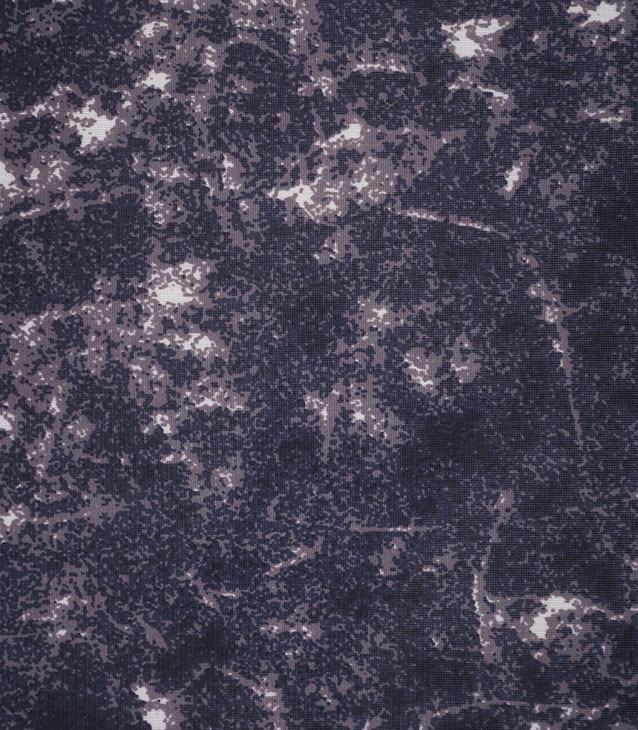 Printing Warp Knitted Polyester FabricQida's printed warp knitted polyester fabric is made with advanced warp knitting technology, which has a smooth and consistent texture, exquisite and durable. The uniq...View Product →
Artwork has to be built for the chemistry. Very fine lines can break down or become weak points, so most studios keep a minimum line width and avoid large, isolated islands of open area in a high-stretch fabric. Repeats should be planned with the grain, and any burnout pattern combined with digital printing, embroidery or foiling needs a process sequence that does not damage the burn.
Durability deserves early attention. Burnout reduces tear strength where the cellulose disappears, and laundering accelerates the loss if residual acid is not fully neutralized. A pattern that looks beautiful in a strike-off can still fail after five home washes. Our overview of warp knitted fabric durability and comfort walks through the same testing logic for knit structures.
 Warp Knitted Polyester Mesh FabricWarp knitted polyester mesh fabric features a uniform, fine mesh structure that is both strong and breathable. Its complex structure results in a smooth, stable surfac...View Product →
Burnout is a chemical process, and chemical processes drift. The defects below are the ones buyers report most often, and each has a practical countermeasure in the mill.
A written specification, a sealed strike-off and a defined washing protocol remove most of the risk. Buyers often add third-party inspection, and a mill with integrated production can adjust the recipe faster when a batch drifts.
Zhejiang Qida Textile has designed, produced and marketed fabric since 1998 from its base in Changxing, Zhejiang. The factory runs 62 Karl Mayer warp knitting machines, more than 100 circular knitting machines, elasticizers, warping equipment and nonwoven lines, with a combined capacity above 30,000 tons a year. Products serve sportswear, fashion, swimwear, home textile and protective applications, and export markets include Italy, Poland, Mexico, Brazil and India.
For burnout-related projects, that mix matters. Blend selection, knit structure, dyeing sequence and finishing can be discussed as one brief instead of four separate purchases. Our technical team supports custom development, and finished goods can be inspected by us or by a nominated third party. A look at our factory and equipment shows what the production floor can hold.
Burnout printing rewards preparation. Choose a blend that satisfies both the design intent and the strength requirement, test the recipe on the real fabric, protect the process sequence, and verify durability in the wash rather than on the sample table. Send us your target blend, pattern and end use, and we will come back with a base fabric recommendation and a strike-off plan.
Recommended Products

27th floor , South building, 1358# Mingzhu North Road, Changxing County Zhejiang province, China

+86-13665757726

+86-0572-6228207

+86-0572-6228207


Copyright © ZHEJIANG QIDA TEXTILE CO., LTD. Rights Reserved. Activewear Fabric Suppliers Sportswear Fabric Manufacturers



 English
 中文简体
中文简体