Home / News / Industry news / Digital Print Textile Explained: Inks, Base Fabrics, and Mill Workflow

2026-11-09
Anyone who has spent a shift at the end of a print line knows the printer is rarely the problem. A digital print textile is the sum of a dozen earlier decisions — yarn, knit structure, pre-treatment, ink chemistry, fixation — and the print head only executes the last of them. This is a walk through those decisions the way we handle them on our own floor, written for buyers and product developers who need to specify a print and know what to expect back.
Content
In plain terms, a digital print textile is fabric printed by inkjet heads that receive a design as a digital file. There is no screen to burn and no engraved roller to cut, so the artwork travels from a file to cloth without a plate-making step in between.
That single change removes several constraints buyers used to plan around:
What digital printing does not do is remove the need to prepare the fabric. A knit still has to be scoured, heat-set to a stable width, and pre-treated so the ink stays where the head put it. Skip those steps and the print will look fine on the roll and fail after the first wash.
Most mills run one, two or all three of the systems below. The choice is driven by fiber content first and by the design second, because ink and fiber have to be chemically compatible.
| Ink system | Typical fibers | Hand feel after print | What to watch |
|---|---|---|---|
| Reactive dye | Cotton, viscose, mercerised cloth, cellulosic blends | Very soft; ink sits inside the fiber | Needs steaming and washing-off; full depth appears only after wash |
| Disperse / sublimation | Polyester and poly-rich blends | Soft, with almost no added weight | Poly only; heat can dull elastane if temperature drifts |
| Pigment | Almost any fiber, blends and nonwovens included | Slightly firmer because of the binder | Crocking and wash durability depend on binder and curing |
In practice the fiber usually decides for you. A polyester swimwear knit goes the disperse route, a cotton or viscose jersey to reactive, and a blended or nonwoven substrate often to pigment because it needs no washing-off.
A woven fabric holds its geometry. A knit is a series of loops under tension, and that changes how it takes ink. Two things matter most: the cloth has to arrive at the head at a consistent width with even moisture pickup, and it has to stay dimensionally stable through steaming and washing.
Warp-knitted cloth is generally the steadier of the two — dense, dimensionally stable, predictable through the line. Weft knits, especially single jersey with elastane, stretch in every direction and can distort as they pass through the padder. A printer who does not adjust tension and dwell time for those fabrics produces a design that looks sharp on the roll and wavy once it is cut.
The other quiet problem is shade variation across the width. On a knit, small differences in yarn lot, loop density or pre-treatment pickup can shift color by a visible step. Good mills measure and approve the first meters, not the last.
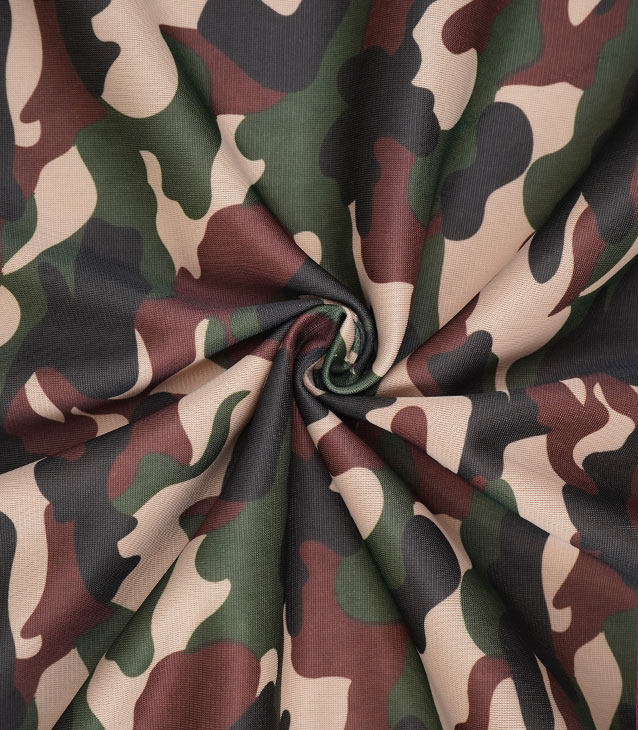
 Printed Warp-Knitted Polyester Fabric for Clear DesignsA smooth, stable warp-knitted polyester that supports sharp prints and durable garment use, available with custom size, thickness and design options.View Product →
Print quality gets the attention, but the base cloth decides whether the garment survives its first season. A few notes from the fabrics we print most.
Chlorine resistance, stretch recovery and colorfastness to light and salt water matter more than print detail. The surface also has to hold ink through repeated stretching without cracking. We cover the fiber and finishing side of this in more detail in our guide to swimwear fabric selection.
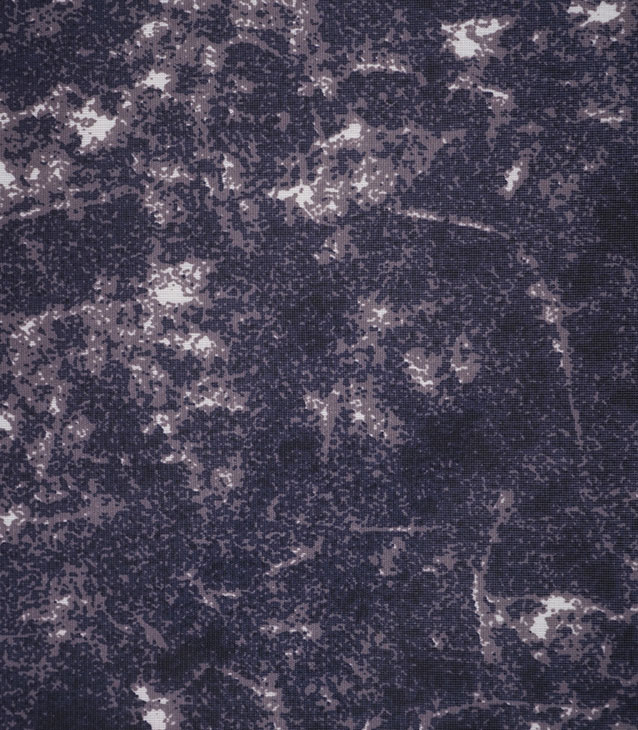
 Warp-Knitted Swimsuit Cloth for Performance SwimwearA soft, stretchable swimwear fabric designed for chlorine and salt water, offering recovery and comfort for performance swim applications with customization available.View Product →
Open structures are popular for breathability but awkward to print. The design reads differently on a mesh surface than on flat jersey, and the open areas break up fine lines. Always test artwork on the actual mesh rather than a substitute — a proof on plain jersey tells you very little about what the mesh will do.
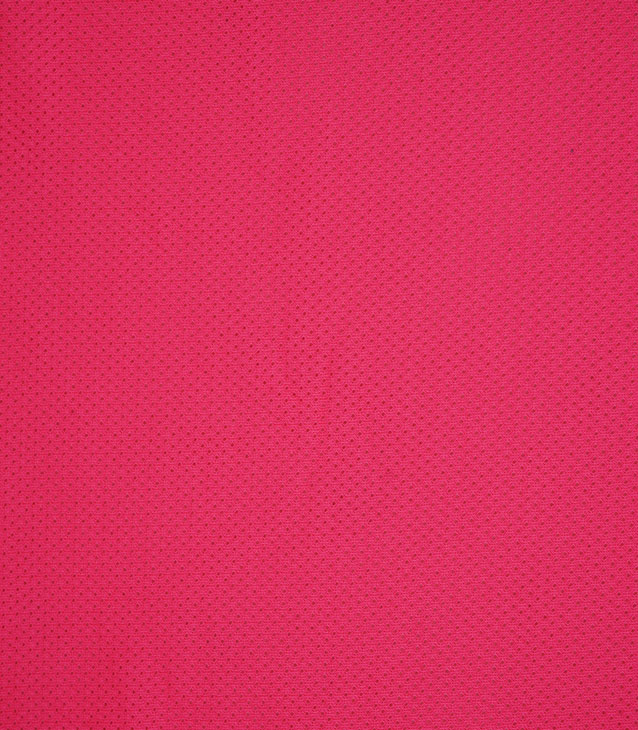 Warp-Knitted Polyester Mesh Fabric for Breathable TextilesA stable, breathable polyester mesh with uniform openings and abrasion resistance, suited to sports, outdoor, lining and accessory applications with custom specifications.View Product →
Here the print is the product, so hand feel dominates. Brushed and pile fabrics such as polar fleece and loop velvet hold pigment well but lose definition, which is why bold shapes usually outperform fine detail on them. Smooth polyester and mercerised cloth take photographic detail cleanly and are the easiest place to start if a buyer is new to digital printing.
Skipping step four is the most common reason a bulk order disappoints. It is also the cheapest step to repeat.
Digital printing is often described as the sustainable option, and part of that is true. There are no screens to develop and wash out, less dye paste is mixed and discarded, and printing to demand reduces the dead stock that has weighed on this industry for decades. A design can be repeated in small quantities instead of being guessed in thousands of meters.
The rest of the story is more complicated. Reactive printing still requires steaming and washing-off, which is water-intensive. Pigment printing skips the wash but leans on binder chemistry and curing energy. Pre-treatment consumes water either way. The honest claim is that digital printing wastes less per design, not that it is waterless.
A mill that answers these without hesitation is usually a mill that has already solved them internally.
We are a fabric factory rather than a trading office, and that shapes how we answer those questions. Zhejiang Qida Textile was founded in 1998 and runs warp knitting, weft knitting and nonwoven lines under one roof: 62 Karl Mayer warp knitting machines, 100 circular machines, and annual capacity above 30,000 tons. Because the base cloth and the print come from the same building, questions about shrinkage, hand feel or shade get settled between departments instead of between companies. You can see the equipment lineup on our factory page.
Our printed fabrics are made to order for swimwear, sportswear, fashion and furnishing programs, and we export to buyers in Italy, Poland, Brazil, Mexico, India and elsewhere. Every project starts the same way — with a conversation about what the fabric has to do, not just what it has to look like.
Digital print textile is a young enough category that specifications are still negotiated case by case. That is good news for buyers who ask precise questions, and less good news for anyone hoping a file and a deadline are enough. Bring the mill your end use, your care label and your tolerance, and the printing itself tends to be the simplest part of the job.
Recommended Products

27th floor , South building, 1358# Mingzhu North Road, Changxing County Zhejiang province, China

+86-13665757726

+86-0572-6228207

+86-0572-6228207


Copyright © ZHEJIANG QIDA TEXTILE CO., LTD. Rights Reserved. Activewear Fabric Suppliers Sportswear Fabric Manufacturers


 English
 中文简体