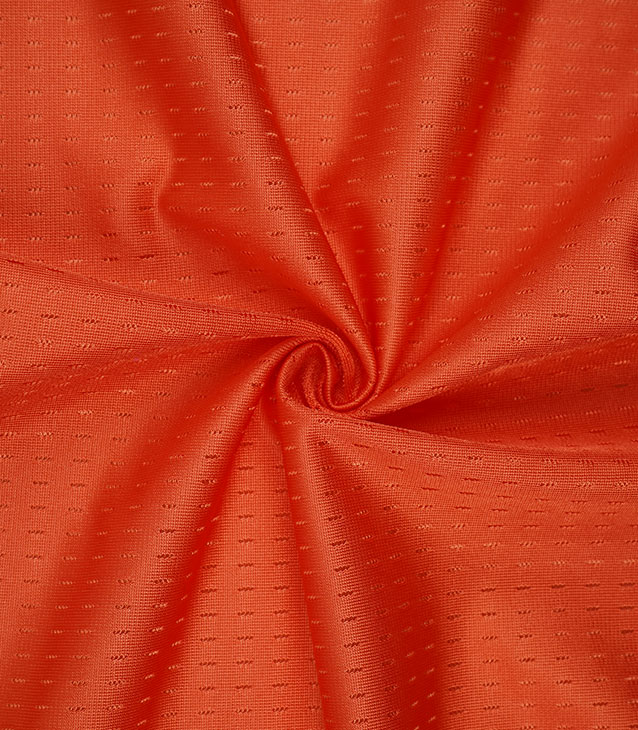
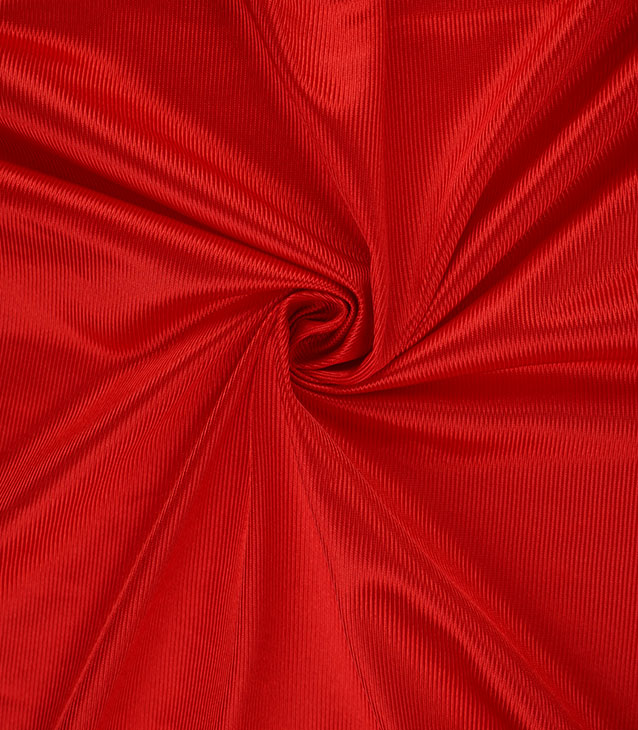
Home / News / Industry news / Weft Knitted Scuba Fabric: Double Knit Poly-Spandex with Matte Finish Explained
2026-06-04
Fabric buyers evaluating stretch knits for structured garments face a specific problem: most options trade off in ways that compromise the final product. High-stretch fabrics lose shape under wear. Stiff structured fabrics restrict movement. Shiny surfaces expose construction flaws and limit design versatility. Weft knitted scuba fabric — built from a double knit poly-spandex construction with a uniform matte finish — resolves all three of these trade-offs in a single material.
This guide explains exactly how that resolution works, from the loop-level mechanics of weft knitting to the practical specifications wholesale buyers need when sourcing weft knitted scuba fabric for fashion and sportswear at scale.
Content
In weft knitting, a continuous yarn travels horizontally across the fabric width, forming interlocking loops in sequence. Each loop is drawn through the one before it, creating a structure where the fabric stretches along the same axis the yarn travels. This horizontal loop geometry is what gives weft knits their inherent two-way and four-way stretch — no weave or warp knit construction achieves the same elasticity without additional processing.
For scuba fabric specifically, the weft knitting process is run on circular knitting machines that produce a seamless tube of double-faced fabric. Two sets of needles work simultaneously on opposite sides of the cylinder, creating two interconnected fabric layers in a single pass. The result is a material that is dense and dimensionally stable on the surface while maintaining the elastic loop structure internally — which is precisely what gives scuba its characteristic firmness without rigidity.
Warp knitting and woven constructions can produce similarly stable fabrics, but neither can replicate the specific balance of stretch recovery, surface smoothness, and structural weight that the weft double knit process delivers. This is why scuba has held its position as a go-to fabric for structured fashion garments and performance apparel for decades, regardless of trend cycles.
The dense, smooth texture that defines scuba is a direct product of its double knit architecture. Because both fabric faces are knitted simultaneously and locked together through interlocking loops, the surface loops are held under consistent tension from both sides. This bilateral tension flattens the loop crowns against the fabric surface, producing a fine, even texture with minimal fiber protrusion.
That same flattening effect is what creates the uniform matte finish. When loop crowns lie flat and parallel to the fabric surface, incident light is scattered diffusely rather than reflected specularly — the physical mechanism behind a non-shiny appearance. Fabrics with raised, curved, or irregular loop surfaces reflect light in varied directions, creating the sheen or gloss seen in single jersey or standard interlock. In double knit scuba, the controlled loop geometry suppresses this reflection consistently across the full fabric width.
For designers, a matte finish fabric carries practical advantages beyond aesthetics. It conceals minor surface imperfections in cut-and-sew construction, holds printed patterns without the distortion caused by surface reflection, and photographs cleanly under both studio and natural light conditions. In fashion applications — fitted dresses, structured skirts, tailored bodices — this surface quality directly affects the polished, sophisticated appearance of the finished garment.
Our full weft knitted fabric range is produced using this same double knit methodology across different construction variants, ensuring consistent surface quality standards across the product line.
The fiber composition of a weft knitted scuba fabric determines how it behaves under stress — and, more importantly, how reliably it returns to its original dimensions after that stress is removed. The polyester-spandex blend used in scuba is not arbitrary; each component plays a specific structural role.
Polyester provides the loop framework. Its high tenacity and dimensional stability under heat and moisture mean that the fabric's knit structure does not deform during wear or washing. Polyester filament yarns used in scuba production are typically fine-denier, which contributes to the smooth surface texture and allows for tight loop packing without adding excessive weight.
Spandex — typically present at 5–15% of the blend by weight — functions as a spring within each loop. When the fabric is stretched, spandex filaments extend; when tension is released, they contract and pull the polyester loops back to their original geometry. The spandex percentage directly governs the firmness-to-flexibility ratio: blends toward the lower end produce a more structured, fashion-weight handle; blends toward the higher end deliver the compression and snap-back expected of performance activewear.
This is the engineering basis for what buyers and designers describe as scuba's "slightly stretchy yet structured" character. It is not a compromise between stretch and stability — it is a tunable property that can be adjusted at the fiber blending stage to meet specific end-use requirements. This distinguishes well-specified scuba from commodity stretch fabrics, and from constructions like interlock weft knitted fabric, which uses a similar double knit method but typically achieves a softer, lighter-weight result suited to different applications.
| Spandex Content | Handle Character | Recommended Application |
|---|---|---|
| 5–8% | Structured, firm, minimal elongation | Fashion dresses, skirts, structured bodices |
| 8–12% | Balanced stretch with stable recovery | Everyday wear, casual sportswear, fitted tops |
| 12–18% | Compressive stretch, strong snap-back | Performance activewear, dance, compression garments |
A matte surface is not simply a stylistic preference — it is a functional specification that influences how a fabric behaves across the entire production and wear lifecycle.
In fashion design, matte finish fabrics are workhorses precisely because they are visually neutral. They do not compete with garment structure, color, or print. A cobalt blue matte scuba skirt reads as cobalt blue; the same color in a shiny knit reads as cobalt-blue-and-light, with the surface reflection as a secondary visual element the designer did not choose. For collections built around precise color work or architectural silhouettes, this distinction matters substantially.
In sportswear and performance apparel, matte finish fabrics carry a different kind of value. High-shine athletic fabrics are polarizing among end consumers — many find the appearance too casual or too conspicuous for gym environments, studio classes, or athleisure crossover contexts. Matte poly-spandex scuba threads the needle between athletic function and fashion-forward versatility, making it a strong candidate for multi-use activewear lines that consumers expect to wear from training sessions to everyday settings.
The scuba construction also holds color exceptionally well. The tight loop packing limits dye migration during washing, and the polyester base accepts both disperse dye and sublimation print processes with high fidelity. For brands building seasonal colorways into structured fabrications, this means consistent color delivery across production runs — a practical quality advantage in addition to the surface aesthetic one.
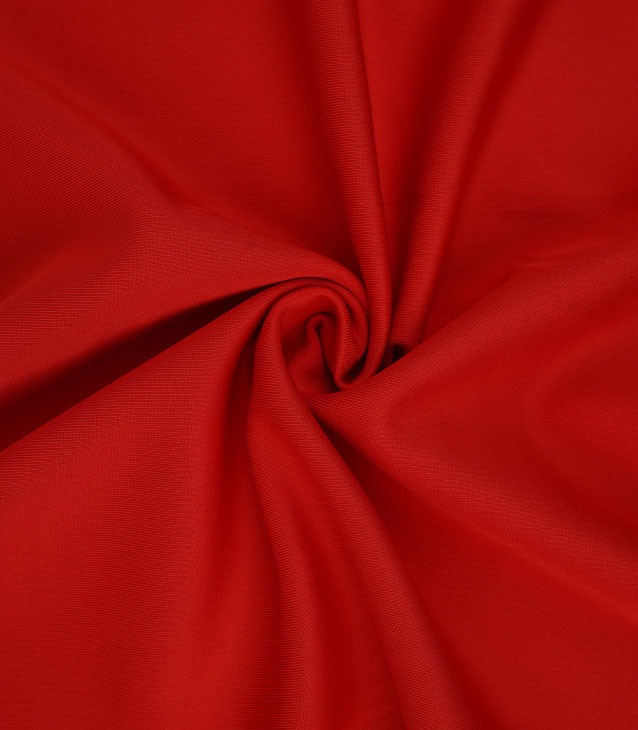
Buyers sourcing double knit poly-spandex scuba at wholesale volume need to evaluate beyond the hand-feel sample. Several technical specifications determine whether a fabric will perform consistently at production scale and across multiple wash cycles.
GSM (grams per square meter) is the starting point. Scuba fabrics typically range from 220 to 340 GSM, with fashion-weight constructions toward the lower end and structured performance fabrics toward the higher. Buyers should specify GSM tolerance (typically ±5%) in purchase contracts to ensure batch consistency.
Fiber composition and denier affect both surface texture and long-term durability. Fine-denier polyester filaments (75D or below) produce a smoother matte surface; coarser yarns introduce more visible texture but increase fabric robustness. The spandex denier and coverage factor determine how evenly elastic recovery is distributed across the fabric width — an important variable for cut-and-sew operations where edge stability affects pattern accuracy.
Shrinkage and wash stability must be tested before bulk production commitment. Weft knit constructions are inherently prone to relaxation shrinkage — the fabric shortens in length as loop tension releases during the first wash cycle. Well-finished scuba fabrics undergo compacting or heat-setting during production to pre-shrink the fabric and stabilize dimensions. Buyers should request wash test data (typically at 40°C, 3 cycles) with shrinkage values below 3% in both warp and weft directions.
For specialized applications — panels in weft knitted mesh fabric for activewear panels, zonal compression zones, or printed fashion pieces — fabric sourced in roll form with consistent width and weight across the full roll length is essential for efficient cutting room yield. Specifying roll weight minimums and packaging requirements upfront prevents the yield losses that come from roll-end piecing in production.
Zhejiang Qida Textile Co., Ltd. has been producing knitted fabrics since 1998, operating from Changxing County, Zhejiang Province — one of China's most established textile manufacturing regions. The factory has invested over 200 million RMB in equipment and process upgrades, sourcing circular knitting machines and finishing lines from Germany, South Korea, and Taiwan.
Current production capacity includes 100 circular knitting machines dedicated to weft knitted fabric production, supported by 62 Karl Mayer warp knitting machines, 22 warping machines, and 6 elasticizers. Annual output exceeds 30,000 tons, supplying both domestic and international markets across fashion, activewear, swimwear, and performance apparel categories. Products are exported to India, Brazil, Mexico, Italy, Russia, Poland, and other countries.
The weft knitted scuba fabric line is manufactured to customer specifications — GSM, fiber ratio, roll width, and colorway — with technical support from experienced in-house engineers who can develop and validate custom constructions before bulk production commitment. This development capability is particularly relevant for brands building signature fabrications that require consistent quality across multiple seasonal runs.
Quality management adheres to international certification standards, ensuring that fabric specifications are documented, tested, and traceable from yarn input through finished roll inspection. For wholesale buyers building supplier relationships that need to scale, this traceability is foundational to production reliability.
Explore Qida Textile's full product range — including weft and warp knitted constructions across fashion, activewear, and functional textile categories — or contact the team directly for a personalized quote on weft knitted scuba fabric specifications.

27th floor , South building, 1358# Mingzhu North Road, Changxing County Zhejiang province, China

+86-13665757726

+86-0572-6228207

+86-0572-6228207


Copyright © ZHEJIANG QIDA TEXTILE CO., LTD. Rights Reserved. Activewear Fabric Suppliers Sportswear Fabric Manufacturers



 English
 中文简体
中文简体